
Eye Examinations at Jacksons Styling Opticians
Regular eye examinations do more than ensure clear vision — they provide reassurance about the ongoing health of your eyes. Many eye conditions develop gradually and without obvious symptoms, which is why a thorough, unhurried examination is so important.
Our Enhanced Eye Health Examination is a comprehensive assessment of both your vision and ocular health, lasting approximately 45 minutes. This extended appointment allows your optometrist the time to fully understand your visual needs, assess eye health in detail and discuss any findings clearly and calmly with you.
What our Enhanced Eye Health Examination includes
Your examination may include a combination of advanced assessments, tailored to you:
-
Detailed history and symptom assessment
-
Refraction to determine your most accurate prescription
-
External eye examination using slit lamp biomicroscopy
-
Internal eye examination using indirect slit lamp biomicroscopy
-
Measurement of intraocular pressure using iCare or Goldmann tonometry
-
Suprathreshold visual field testing
-
Optical Coherence Tomography (OCT) scanning with the Topcon Maestro
-
Optomap ultrawide-field retinal imaging
-
Anterior eye OCT assessment where clinically indicated
-
Clear discussion of findings and personalised recommendations
-
Referral for further investigation where necessary
-
Advice on ocular health, lifestyle and nutrition
Not every test is required for every patient. Your optometrist will recommend the most appropriate assessments based on your individual needs and clinical findings.
NHS Sight Tests and Enhanced Care
If you are entitled to an NHS sight test, you may still choose to benefit from the additional assessments included in our Enhanced Eye Health Examination for a modest supplementary fee. Many patients value the added reassurance and depth of assessment this provides, and our optometrists routinely recommend it as part of proactive eye care.
Find out more about Enhanced Eye Health Examinations here
Dry Eye Syndrome
Do your eyes stream in the wind?
Does your vision blur when reading?
Do your eyes feel gritty after using a computer?
Do you wake with sore or uncomfortable eyes?
If so, you may be experiencing Dry Eye Syndrome, often referred to simply as dry eye.
Dry eye affects up to 40% of people at some point in their lives. It becomes more common with age, particularly after 40, and is more frequently seen in women. Symptoms can vary from mild irritation to persistent discomfort and may include a gritty or burning sensation, itching, blurred vision, redness, eyes sticking together on waking and, paradoxically, watery eyes.
Why dry eye happens
Dry eye is caused by a disruption to the tear film, which protects and nourishes the surface of your eyes. If your tears evaporate too quickly, are of poor quality, or are not evenly distributed across the eye, the surface becomes dry and irritated.
Conditions such as blepharitis (inflammation of the eyelids) and meibomian gland dysfunction (blockage of the oil-producing glands in the eyelids) commonly contribute to dry eye symptoms.
Environmental and lifestyle factors can also make symptoms worse, including:
-
Prolonged screen use or reading
-
Air conditioning, heating or windy weather
-
Age and hormonal changes
-
Certain occupations
-
Previous laser eye surgery
Some medical conditions — including arthritis, thyroid disease, lupus and Sjögren’s syndrome — as well as certain medications, can also increase the likelihood of dry eye. Contact lens wearers are particularly prone.
Why dry eye is worth treating
Although many people feel they can “put up with” dry eye symptoms, untreated dryness can increase the risk of recurrent infections such as styes, cysts and conjunctivitis. Over time, severe or persistent dry eye can damage the surface of the eye, leading to corneal inflammation, ulceration or scarring.
Early assessment and treatment can relieve symptoms, improve comfort and help protect the long-term health of your eyes.
Expert-led dry eye care
Even if you have tried over-the-counter or GP-prescribed eye drops with limited success, more effective treatment options are often available.
Expert dry eye assessment as part of your eye examination
Dry eye assessment is now fully integrated into our eye examinations, allowing your optometrist to assess both your vision and the health of the ocular surface in a single, unhurried appointment.
Your optometrist will carefully examine the anterior eye, assess tear film quality and eyelid health, and identify contributing factors such as blepharitis or meibomian gland dysfunction. Based on these findings, we will discuss your symptoms in detail and recommend a personalised dry eye management plan, tailored to your eyes, lifestyle and visual needs.
Where appropriate, treatment may include targeted advice, prescription or non-prescription therapies, and ongoing monitoring to ensure your symptoms remain well controlled. By bundling dry eye assessment into your eye examination, we are able to provide continuity of care, earlier intervention and more effective long-term management.
Find out more about our Dry Eye Clinic here
Optical Coherence Tomography (OCT)
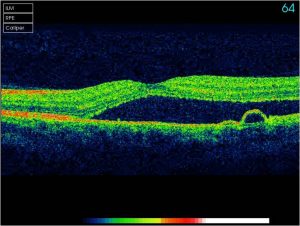
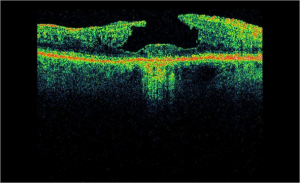
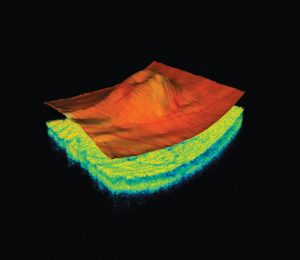
Optical Coherence Tomography (OCT) creates a highly detailed, three-dimensional image of the back of the eye (the retina), allowing your optometrist to examine its structure in microscopic detail. Using safe, low-powered laser light, the OCT scan captures precise cross-sectional images of the retinal layers. The test is completely non-contact — nothing touches or blows on your eye — and takes only a few moments.
A helpful way to think about OCT is to imagine the retina as a layered cake. When we look into the eye using traditional examination methods, we see only the surface — the icing on the cake. OCT allows us to take a slice through the cake, revealing all the individual layers beneath the surface. This enables us to identify subtle changes, focus on specific areas of concern and detect early signs of disease long before vision is affected.
We recommend that all patients have an initial baseline OCT scan, as it provides a valuable reference for future comparisons. OCT is particularly useful for patients with risk factors or concerns relating to glaucoma, macular degeneration, and other retinal conditions.
OCT scanning is included as part of our Enhanced Eye Health Examination and is available as an optional upgrade for patients attending under the NHS sight test.
Optomap Retinal Imaging
A wide-field view of the retina without dilation
The Optomap retinal examination provides a wide, panoramic view of the back of the eye (the retina), capturing over 80% of the retinal surface in a single image. This allows your optometrist to assess both the central and peripheral retina in far greater detail than is possible with traditional examination methods.
The image is captured in just a quarter of a second, making the test quick and comfortable — even for patients who are sensitive to bright lights. In most cases, Optomap imaging allows a thorough retinal assessment without the need for dilating eye drops, avoiding the temporary blur and light sensitivity dilation can cause.
By viewing such a large area of the retina at once, your optometrist can more easily identify peripheral retinal changes and subtle abnormalities, while ensuring the examination remains relaxed and comfortable.
Who is Optomap recommended for?
Optomap retinal imaging is suitable for most patients and is particularly valuable for those who:
-
Prefer to avoid dilating eye drops
-
Value a more comfortable retinal examination
-
Want a more comprehensive assessment of retinal health
-
Have risk factors for retinal disease
Optomap retinal imaging is included as part of our Enhanced Eye Health Examination and is available as an optional upgrade for patients attending under the NHS sight test.
Contact Lenses
Do you wear contact lenses but find they become uncomfortable as the day goes on?
Do you feel your vision should be clearer in your lenses?
Have you tried contact lenses in the past but struggled with handling or removal?
Many contact lens problems are not caused by your eyes, but by lenses that are poorly suited to your prescription, lifestyle or ocular surface.
We provide contact lens fitting and aftercare for both soft and rigid contact lenses, and we particularly enjoy working with patients who have previously struggled with comfort, handling or visual quality. By taking the time to understand how you use your lenses day to day, we are often able to improve both comfort and clarity with the right lens design and wearing schedule.
Our principles of care and value extend fully to our contact lens patients. We place strong emphasis on regular aftercare appointments, ongoing advice and proactive eye health monitoring, ensuring your lenses remain safe, comfortable and effective over time.
At the same time, we are mindful of value. Our contact lens pricing and care packages are designed to compare favourably with online suppliers, while offering the reassurance of professional fitting, clinical oversight and ongoing support. Our packages are straightforward, transparent and tailored to meet your individual contact lens needs.
Find out more about contact lenses here
Get in touch
For more information or to make an appointment please call us on 01270 625 889
Book online for an eye examination here
Send us a message using the form below
Request Info