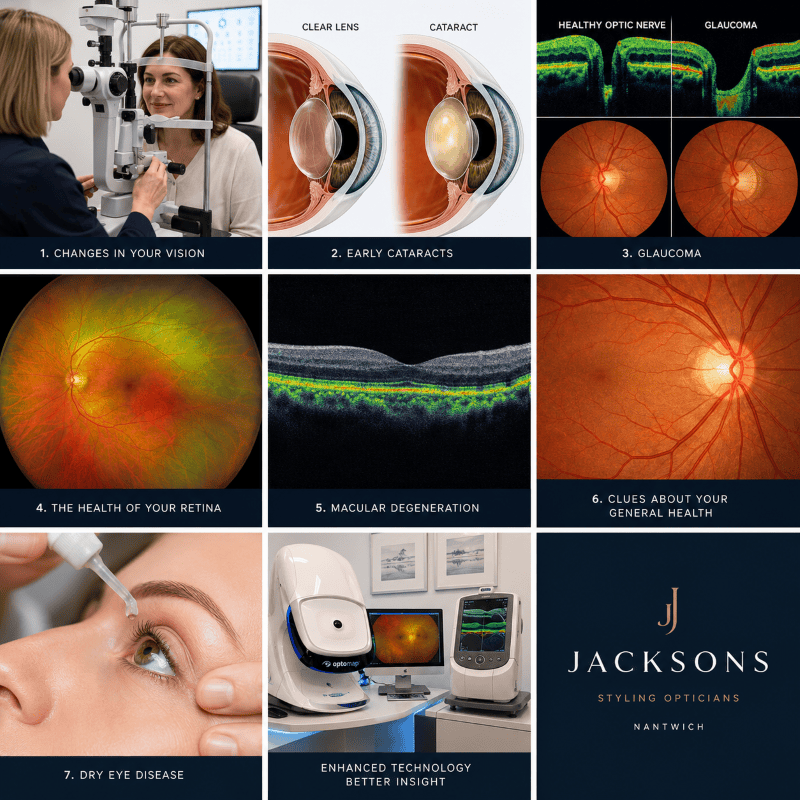
7 Things We Look For During Your Eye Examination (That Have Nothing To Do With Your Glasses)
By Helen Corson, author
7 minute read
Most people book an eye examination because they think their glasses need changing.
Perhaps road signs aren’t quite as sharp as they used to be. Maybe you’re holding your phone a little further away, or you’re finding it harder to read in the evening.
While checking your prescription is an important part of every eye examination, it is only a small part of what we’re actually looking for.
At Jacksons Styling Opticians in Nantwich, every Enhanced Eye Examination is designed to assess not only how well you see, but also how healthy your eyes are. Using advanced technology including Optomap ultra-widefield retinal imaging and OCT (Optical Coherence Tomography), we can often detect changes long before they begin to affect your sight.
Many eye conditions develop silently. By the time your vision changes, irreversible damage may already have occurred.
That’s why a comprehensive eye examination isn’t simply about whether you need stronger glasses. It’s one of the most important health checks you can have.
Here are seven things we’re looking for every time we examine your eyes.
1. Changes in Your Vision
(Yes, we do still check your glasses!)
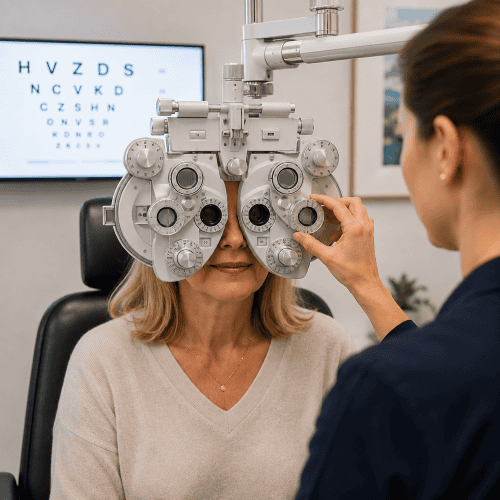
Although there’s much more to an eye examination than prescribing spectacles, your vision remains incredibly important.
We carefully assess how your eyes work both individually and together, ensuring you receive the most accurate prescription possible.
Sometimes patients assume they simply need stronger glasses when the real cause is something completely different.
Blurred vision may be caused by:
- Cataracts
- Dry eyes
- Early macular degeneration
- Diabetes
- Certain medications
- Changes to the surface of the eye
This is one reason why buying glasses without a proper eye examination can sometimes delay the diagnosis of more significant eye conditions.
2. Early Cataracts
One of the most common questions we hear is:
“Am I getting cataracts?”
The answer is often yes—but that doesn’t necessarily mean they’re causing a problem.
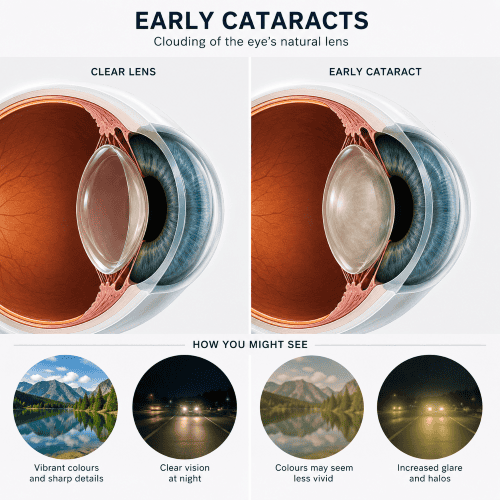
A cataract develops when the natural lens inside the eye gradually becomes cloudy. This usually happens as part of the normal ageing process.
Early symptoms can include:
- Increased glare from headlights
- Colours appearing duller
- Frequent prescription changes
- Difficulty driving at night
Many people adapt so gradually that they don’t realise how much their vision has changed.
During your examination we inspect the natural lens using magnification and specialised illumination, allowing us to identify cataracts long before surgery becomes necessary.
Most cataracts simply need monitoring until they begin affecting your quality of life.
3. Glaucoma – The Silent Thief of Sight
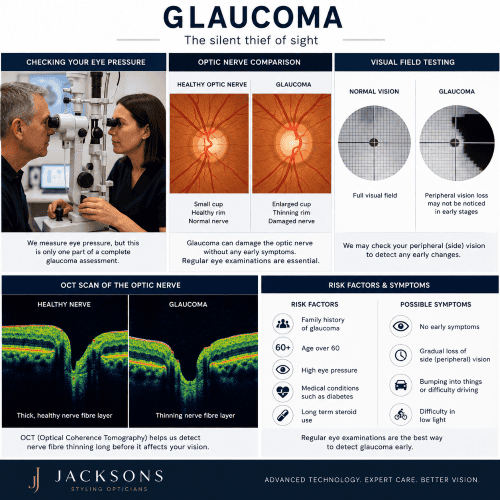
Glaucoma is one of the leading causes of preventable blindness worldwide.
The reason it’s so dangerous is simple:
Most people don’t notice any symptoms until permanent damage has already occurred.
Glaucoma damages the optic nerve, the cable that carries visual information from your eye to your brain.
Unlike many conditions, the vision you lose from glaucoma cannot be restored.
During your Enhanced Eye Examination we assess several different factors including:
- Eye pressure
- Optic nerve appearance
- OCT scans of the optic nerve
- Peripheral vision when appropriate
- Family history
- Your overall level of risk
Many people are relieved to discover that assessing glaucoma involves much more than the old-fashioned “air puff” test.
It is the combination of all these findings that allows us to build a much more accurate picture of your eye health.
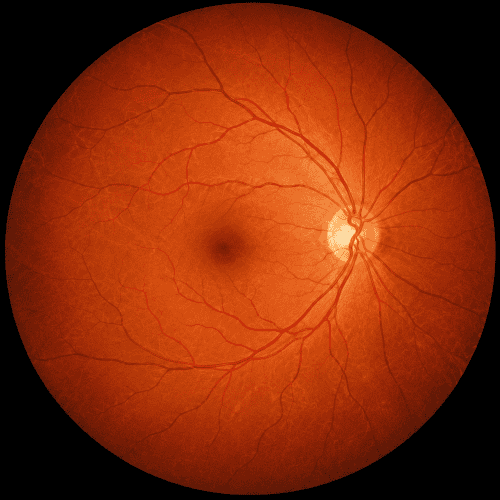
4. The Health of Your Retina
The retina lines the inside of your eye and acts rather like the sensor inside a digital camera.
It captures light before sending signals to your brain, allowing you to see the world around you.
Because the retina is so delicate, even small changes can have a significant effect on vision.
At Jacksons we use Optomap retinal imaging, allowing us to examine an exceptionally wide view of the retina in remarkable detail.
This helps us identify conditions including:
- Retinal tears
- Retinal holes
- Pigment changes
- Areas of thinning
- Bleeding
- Swelling
Many of these changes can be detected before they affect your sight.
If you ever experience flashes, a sudden shower of floaters, or a curtain-like shadow across your vision, you should seek urgent assessment rather than waiting for your next routine appointment.
5. Macular Degeneration
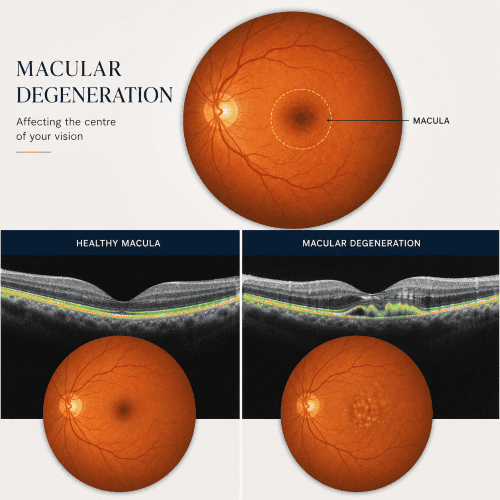
The macula is a tiny part of the retina responsible for your detailed central vision.
It’s what allows you to:
- Read
- Recognise faces
- Drive
- Thread a needle
- Use your phone
Age-related macular degeneration (AMD) is one of the commonest causes of sight loss in older adults.
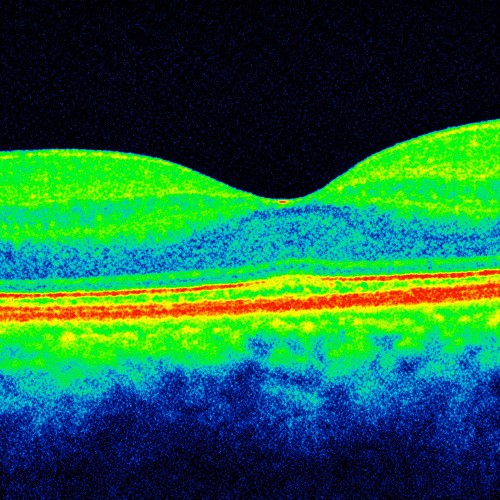
Modern OCT scanning allows us to examine the different layers of the retina in extraordinary detail.
Rather than simply looking at the surface, OCT lets us see beneath it—almost like viewing a cross-section of the retina.
This enables us to detect tiny changes long before they become obvious during a traditional eye examination.
Early detection means appropriate monitoring and, where necessary, timely referral for treatment.
6. Clues About Your General Health
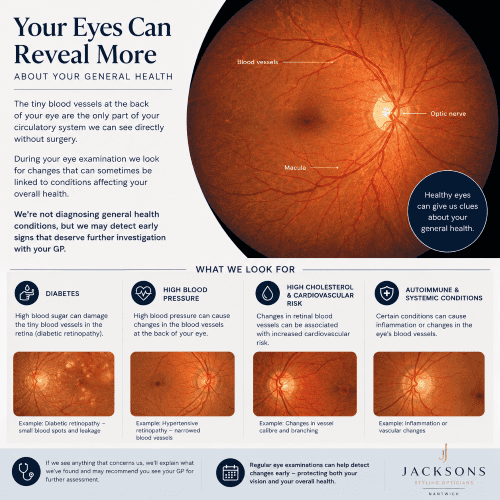
Your eyes are unique because they allow healthcare professionals to see blood vessels and nerves directly without surgery.
Sometimes this means an eye examination reveals signs that may be associated with conditions elsewhere in the body.
These include:
- Diabetes
- High blood pressure
- High cholesterol
- Some autoimmune conditions
We’re not diagnosing these conditions during your eye examination.
However, if we notice changes that concern us, we’ll explain what we’ve found and may recommend that you arrange further assessment with your GP.
Sometimes the eyes provide the first clue that something else deserves investigation.
7. Dry Eye Disease
Many people assume dry eyes simply mean they need stronger eye drops.
In reality, dry eye is often far more complex.
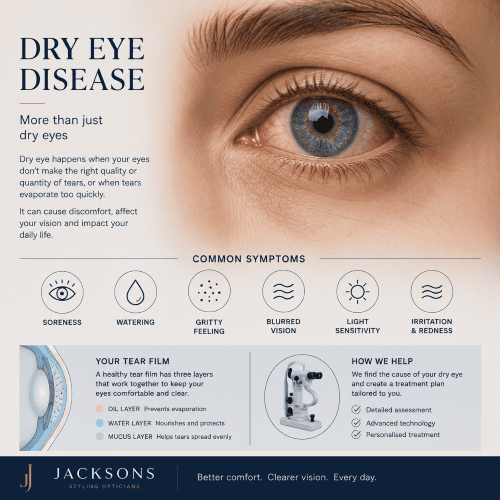
Symptoms can include:
- Burning
- Watering
- Grittiness
- Redness
- Blurred vision that comes and goes
- Light sensitivity
Ironically, very watery eyes can actually be a sign of dry eye disease.
During your examination we assess:
- Your tear film
- The surface of your eye
- Your eyelids
- Your meibomian glands
Understanding the underlying cause allows us to recommend treatment tailored specifically to your eyes rather than relying on trial and error.
Why Technology Matters
Years ago, many eye diseases were only detected once they had already affected vision.
Today’s technology allows us to identify many conditions much earlier.
That’s one reason why our Enhanced Eye Examination includes advanced imaging technologies such as:
- Optomap ultra-widefield retinal imaging
- OCT scanning
- Digital retinal photography
- Detailed slit lamp examination
These don’t replace clinical expertise.
They enhance it.
They allow us to monitor tiny changes over time, explain what we’re seeing, and help you make informed decisions about your eye health.
Looking After Your Eyes Isn’t Just About Seeing Clearly
Many serious eye conditions develop without pain and without obvious symptoms.
By the time your vision changes, treatment may be more complicated than if the condition had been detected earlier.
That’s why regular eye examinations remain one of the simplest ways to protect your sight.
Whether you wear glasses every day, only occasionally, or have never needed them at all, looking after the health of your eyes is just as important as looking after your heart, your teeth or your hearing.

Book Your Enhanced Eye Examination in Nantwich
At Jacksons Styling Opticians, we believe an eye examination should give you more than a new prescription.
It should give you confidence.
Confidence that your eyes have been examined thoroughly.
Confidence that modern technology has been used where it adds real value.
And confidence that, if there is a problem, it has been identified as early as possible.
If it’s been a while since your last eye examination, we’d love to welcome you to our practice on Welsh Row in Nantwich.
Because your eyesight is precious – but your eye health is priceless.